
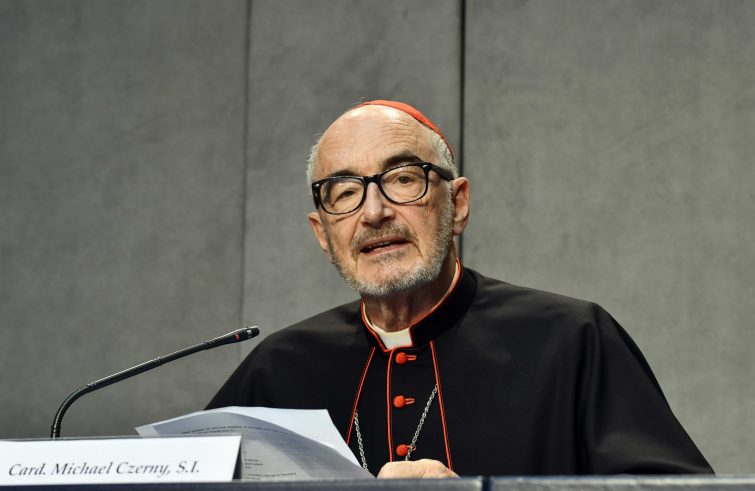
Good morning. First of all, I would like to thank the organizers, in particular Arigatou International and the Pontifical Gregorian University, for inviting me to this Symposium. I’m grateful that a World Day of Action and Prayer for Children has taken place annually for 15 years (1).
Your commitment in advocating for the rights of children is inspiring. And I am delighted that representatives of different religions, the UN and civil society organizations, are here too as advocates of children rights. All children should have the right to grow within their family, the right to study, and also the right to recreation: they have the right to be children. Unfortunately, many of them have no choice but to migrate. And migration puts all those rights in jeopardy.
Migrating involves great sacrifices. Children often pay the highest price, especially when they migrate alone. Their age and status heighten the threat of becoming victims of traffickers and criminal organizations and of being detained. Indeed, the Catholic Church has long been strongly opposed to any form of detention of foreign minors due solely to their migratory status (2).
Children also have the right to a healthy and secure family environment. We must strive to reunitemigrant children who have been separated from their family except when this is not in the child’s best interests.
Once they reach their destination, what’s needed is “’the protection of the fundamental rights of children’, so that they can grow up, receive schooling, be helped and supported, so as not to live in the grip of hunger and violence.” (3) But some host countries lack the resources; others choose to prevent or delay access to education by newcomers. Additionally, migrants and refugees usually lack the free movement needed to take advantage of education opportunities. The results are children not integrating into the local community and not rebuilding their lives. Transitioning to adult life is a challenge for all young people, and foreign minors often struggle with this transition while also bridging between the cultures of their original and new societies.
These challenges clearly touch the Holy Father. In his message for the World Day of Migrants and Refugees 2017, titled “Child Migrants, the Vulnerable and the Voiceless”, he urged everyone to take care of child migrants “…who in a threefold way are defenceless: they are children, they are foreigners, and they have no means to protect themselves.” (4) The Holy Father insists on “... the duty to resolve and regularize the situation of child migrants, fully respecting their dignity and seeking to meet their needs when they are alone, but also the needs of their parents, for the good of the entire family.” (5)
More recently, at the conclusion of the Conference on “Initiatives in Refugee and Migrant Education” (6) the Holy Father emphasized three areas of contribution: research, calling upon “the need for further studies on the so-called ‘right not to emigrate'”; teaching, applauding commitments to establish and continue “educational programmes that benefit refugees”; and finally social promotion. He pointed out that migrants and refugees need to be “welcomed, accompanied, promoted and integrated.” To this end the Pope invited schools and universities to educate their students about migration and create welcoming communities for newcomers.(7)
In 2018, the Holy See contributed Twenty Action Points to the formulation of the Two Global Compacts on migration and on refugees. Here, the Church devoted special attention to minors. Its document advocates for “alternative solutions to detention for legally underage migrants who enter a country without authorisation; by offering temporary custody or foster homes for unaccompanied or separated minors; and by setting up separate centres for the identification and processing of minors, adults and families.” Further, it stresses the importance for underaged migrants not to become irregular and to be able to have “access to primary and secondary schooling at the same
standard as citizens and independently of their legal status”.(9)
Stimulated by the continuous appeals of Pope Francis, many Church entities have poured great effort into assisting foreign minors. The Dicastery for Promoting Integral Human Development constantly organizes consultations with the local Churches to learn about their experience and their best practices for helping migrants and refugees. This year we have been inspired by the theme chosen by the Pope: “Building the future with migrants and refugees”. During consultations in various regions, talk often turned to the key role of young migrants and refugees in building a future together. Involving young migrants and refugees in local life right away recognises them as protagonists and promotes their dignity; this benefits their own growth and allows them to contribute to our societies.
There are many reception and integration facilities managed by dioceses, parishes or Catholic associations. Their service is a tangible expression of the Church’s maternal love for the little ones by giving them somewhere safe to eat, a home if unaccompanied, access to education and medical
care, etc. (10) Another critical service is to listen to children, to provide a safe and comfortable space to express themselves and to deal with their trauma. Finally, different organizations are advocating for the right to family reunification and offering concrete assistance in this regard.(11)
Let me conclude with the word “Together”. Joint and coordinated action is needed in countries oforigin, transit and destination. Governments, organizations and institutions, both religious and civil, must exchange information, dialogue and cooperate, so as to create transnational protection and assistance networks aiming at guaranteeing integral human development for children, who are our future and our hope.
1 First celebration in 2008.
2 For example, see: Arch. G. Caccia statement at the International Migration Review Forum, May 2022;
Arch.G. Caccia statement on the Expulsion of Aliens Nov 2020; Holy See Sponsors Event On Ending The
Detention Of Child Migrants And Refugees, Feb 2018.
3 Pope Francis, Closing of the “Bahrain Forum for Dialogue: East and West for Human Coexistence” Al-
Fida’ Square, 4.11.2022, quoting the Document on Human Fraternity (2019).
4 Pope Francis, Message for the WDMR 2017, 15 January 2017
5 Ibidem
6 Pontifical Gregorian University and the Refugee and Migrant Education Network, 26-29 Sep 2022
7 Pope Franncis, To participants in the meeting on refugees, 29 Sep 2022
8 M&R Section, Twenty Action points for the Global Compacts (2018), point n. 7
9 Ibidem, points n. 8-9.
Fore more info, see https://www.icmc.net/2021/05/25/children-displaced-by-violence-find-a-safe-place/
11 As an example, see https://www.caritasinternational.be/en/?s=family+reunification
